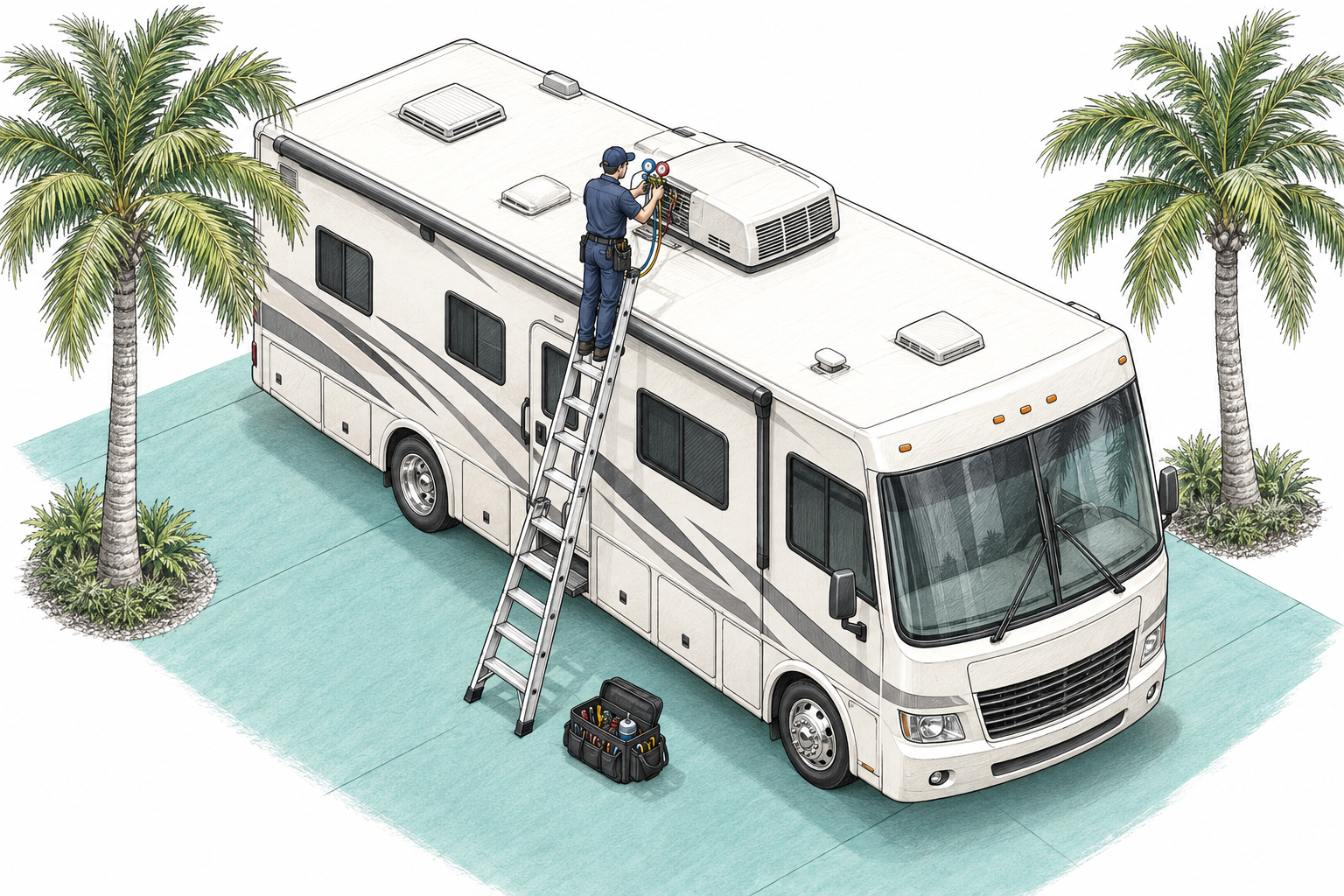
RV Repair Winter Garden provides mobile rv ac tripping breaker throughout Orange, Lake, and Osceola counties. Our certified technician comes to your wherever your RV is parked. Flat-rate pricing quoted before we start - no towing required.
Our certified mobile technicians provide rv ac tripping breaker throughout Winter Garden and all of Orange, Lake, and Osceola counties. We come to your wherever your RV is parked - no towing, no shop drop-off required.
Feat Slide Out in Winter Garden, FLFeat Ac Repair in Winter Garden, FL
Flat-rate pricing is given before any work begins. You approve the price, we do the work. Available 7 days a week, 7 AM to 8 PM.
A breaker trip on AC startup almost always means the run capacitor has failed, causing the compressor to draw 3 to 5 times its normal starting current. A capacitor replacement is a $185 to $265 repair and is the correct fix - resetting the breaker without fixing it risks compressor damage.
Yes - a loose 30-amp or 50-amp connection creates resistance that causes voltage drop. When voltage sags below about 105 volts the AC compressor draws higher amperage to compensate, which trips the breaker. Check that the campground pedestal connection is clean and tight before assuming the AC unit is at fault.
Yes - tripping after a period of running typically indicates a dirty condenser coil or a failing compressor beginning to draw high amperage due to internal damage. A startup trip is almost always a capacitor. A run-time trip needs a full amperage and temperature-split diagnosis.
No - each trip-and-reset cycle stresses the compressor and can accelerate failure. If the AC trips more than twice, stop resetting and call for diagnosis. Running a compressor through repeated trips turns a $200 capacitor repair into a $600-plus compressor job.
A generator producing dirty or low-wattage power is a common cause of AC breaker trips when not on shore power. Verify the generator is producing clean 120V at correct frequency - ideally 59 to 61 Hz. A generator surging or running under load will cause nuisance trips even if the AC unit is healthy.
A breaker that trips under normal load but tests healthy when the AC is disconnected is usually a weak breaker, not an AC problem. RV panel breakers wear out after 10 to 15 years and can trip at 80% of rated current. We replace both the breaker and capacitor on the same call when both show signs of wear.
Yes - a soft-start module like SoftStartRV or MicroAir EasyStart reduces compressor startup current by 65 to 70%, which prevents trips on marginal shore power, small generators, and aging wiring. Installation takes about 45 minutes and costs $145 to $185 for labor plus the device cost.
High ambient temperatures force the compressor to work harder, drawing higher startup and run current. A capacitor that is weak but not yet fully failed can handle cooler morning temps but causes a trip when the compressor is working at maximum demand on a 95-degree Florida afternoon.
Yes - a compressor with damaged windings develops a partial short that increases amperage draw until the breaker trips. This is distinguishable from a capacitor failure by measuring starting amperage with a clamp meter; a bad capacitor shows high starting amps that normalize quickly, while a failing compressor shows persistently elevated run amps.
The breaker itself wears with each trip. The bigger risk is compressor damage if the capacitor is bad and the compressor is trying to start against locked rotor conditions repeatedly. One or two trips while diagnosing is acceptable; 10 or more trips attempting to use the AC creates real compressor risk.
FAQ
Common Questions
A breaker trip on AC startup almost always means the run capacitor has failed, causing the compressor to draw 3 to 5 times its normal starting current. A capacitor replacement is a $185 to $265 repair and is the correct fix - resetting the breaker without fixing it risks compressor damage.
Yes - a loose 30-amp or 50-amp connection creates resistance that causes voltage drop. When voltage sags below about 105 volts the AC compressor draws higher amperage to compensate, which trips the breaker. Check that the campground pedestal connection is clean and tight before assuming the AC unit is at fault.
Yes - tripping after a period of running typically indicates a dirty condenser coil or a failing compressor beginning to draw high amperage due to internal damage. A startup trip is almost always a capacitor. A run-time trip needs a full amperage and temperature-split diagnosis.
No - each trip-and-reset cycle stresses the compressor and can accelerate failure. If the AC trips more than twice, stop resetting and call for diagnosis. Running a compressor through repeated trips turns a $200 capacitor repair into a $600-plus compressor job.
A generator producing dirty or low-wattage power is a common cause of AC breaker trips when not on shore power. Verify the generator is producing clean 120V at correct frequency - ideally 59 to 61 Hz. A generator surging or running under load will cause nuisance trips even if the AC unit is healthy.
A breaker that trips under normal load but tests healthy when the AC is disconnected is usually a weak breaker, not an AC problem. RV panel breakers wear out after 10 to 15 years and can trip at 80% of rated current. We replace both the breaker and capacitor on the same call when both show signs of wear.
Yes - a soft-start module like SoftStartRV or MicroAir EasyStart reduces compressor startup current by 65 to 70%, which prevents trips on marginal shore power, small generators, and aging wiring. Installation takes about 45 minutes and costs $145 to $185 for labor plus the device cost.
High ambient temperatures force the compressor to work harder, drawing higher startup and run current. A capacitor that is weak but not yet fully failed can handle cooler morning temps but causes a trip when the compressor is working at maximum demand on a 95-degree Florida afternoon.
Yes - a compressor with damaged windings develops a partial short that increases amperage draw until the breaker trips. This is distinguishable from a capacitor failure by measuring starting amperage with a clamp meter; a bad capacitor shows high starting amps that normalize quickly, while a failing compressor shows persistently elevated run amps.
The breaker itself wears with each trip. The bigger risk is compressor damage if the capacitor is bad and the compressor is trying to start against locked rotor conditions repeatedly. One or two trips while diagnosing is acceptable; 10 or more trips attempting to use the AC creates real compressor risk.
RV Problem? We Come to You.
Same-day service across Winter Garden and all of Central Florida. Guaranteed flat-rate pricing before we start.