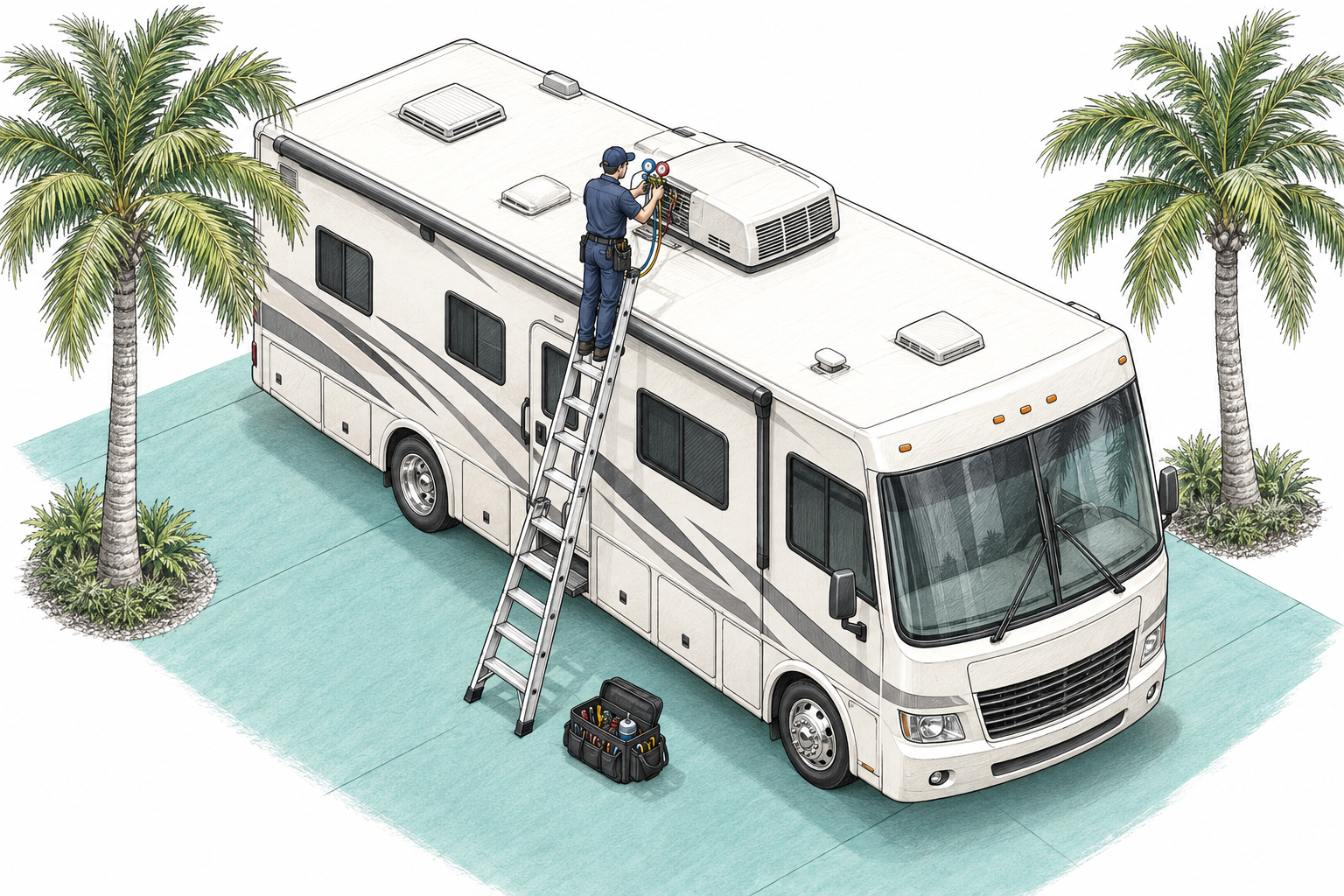
Florida's climate is uniquely brutal on RV rooftop air conditioners, and Central Florida - sitting in the peninsula's interior away from sea breezes - is among the harshest environments any AC unit will ever face. The combination of high ambient temperatures, extreme UV radiation, and year-round high humidity stresses every component in ways that simply do not occur in cooler, drier states.
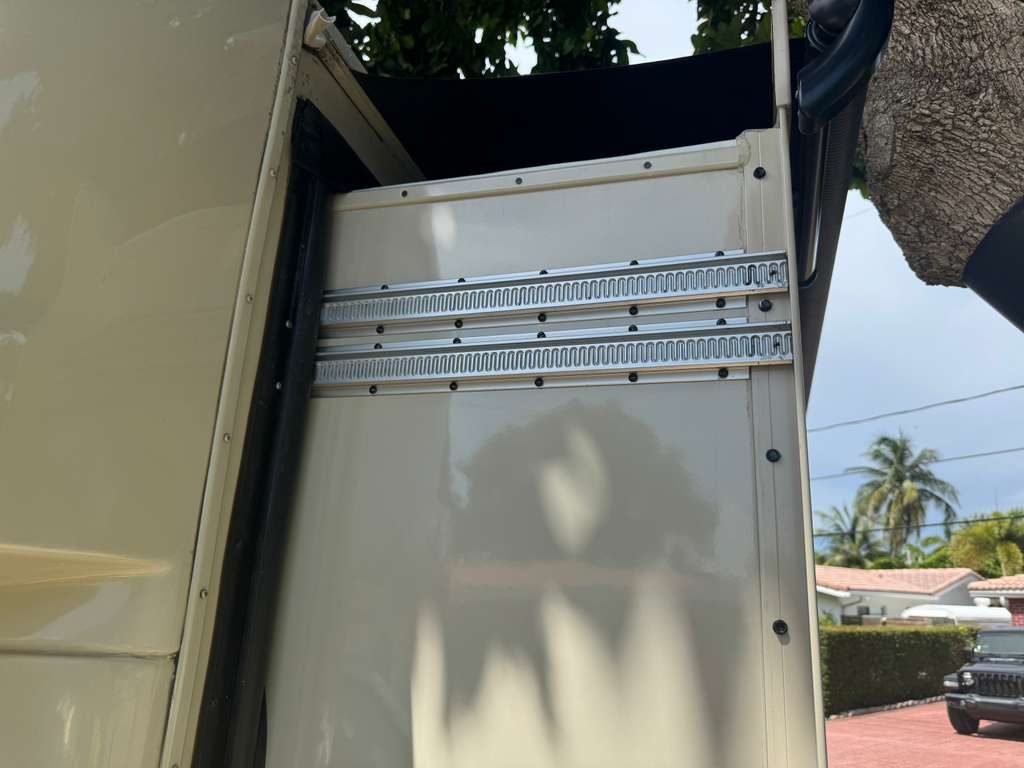
The UV load on I-4 corridor campgrounds is the first factor most RV owners underestimate. The plastic shroud over a rooftop unit is typically ABS or polypropylene, and Florida's sun degrades both within three to five years. Once the shroud starts crazing and cracking, it no longer protects the condenser coil from direct sunlight or from Florida's afternoon thunderstorm downpours.
A saturated condenser that cannot shed heat drops system efficiency by 20 to 30 percent, meaning the compressor runs longer cycles and accumulates more wear hours per cooling ton. We routinely see units at Lake Louisa State Park and Kelly Park Rock Springs campground that look structurally fine from the ground but have UV-bleached, brittle shrouds that are one hard rain from cracking apart.
Oak pollen is a second factor that surprises out-of-state owners. Central Florida's live oaks drop a heavy, fine-grained pollen load from late February through April, and that pollen is exactly the right particle size to pack tightly into rooftop condenser fins. A filter-cleaning schedule adequate in Arizona or Colorado will leave a Winter Garden RV running at 60 percent capacity by May.
We have pulled condenser coils at Disney Fort Wilderness that were coated in a solid mat of pollen and road dust, reducing airflow so severely that the compressor head temperature was running 40 degrees above design spec. Cleaning the condenser coil twice per year - once in May and once in October - is the single highest-return maintenance task a Central Florida RV owner can perform.
Humidity drives the third failure mode: electrical corrosion. The junction boxes, capacitor terminals, and fan motor connectors on most rooftop units are rated for occasional moisture exposure, not for the persistent 80 to 90 percent relative humidity common from June through September in Orange and Lake counties. Aluminum terminals oxidize, spade connectors develop high-resistance joints, and capacitor cans corrode from the outside in.
A capacitor that tests within spec on a cool morning may fail under load during a 98-degree August afternoon. We carry replacement capacitors for every major unit - Dometic Brisk II, Coleman Mach 8, Coleman Mach 15, and Penguin - on every service call in the summer months because the failure rate is that predictable.
Seasonal patterns also shape what we see on service calls. The June-through-September stretch, when overnight lows rarely drop below 75 degrees, is when units run almost continuously for days at a time. Continuous operation is the enemy of brush-type fan motors and of the soft-start thermistor on units that lack a hard-start kit.
Installing a hard-start capacitor kit on any unit older than five years is a straightforward upgrade that extends compressor life significantly in a continuous-run climate. We recommend it to every customer whose rig spends the summer in Central Florida regardless of whether they are camping at Wekiwa Springs, parked in a Winter Garden driveway, or full-timing at Magnolia Park.
| Brand / Model | Common Issue in Central Florida |
|---|
| Dometic Brisk II | Fan motor and run capacitor failures peak June through August from continuous operation in 95-plus degree ambient heat - capacitor replacement is the most common call we get on this unit |
| Dometic Penguin II | Control board failures from campground voltage spikes, and refrigerant loss through the Schrader service port which corrodes in Florida humidity |
| Coleman Mach 8 | Fan blade stress fractures from road vibration on units older than 5 years - a cracked blade will destroy the evaporator coil if not caught early |
| Coleman Mach 15 | Compressor hard-start failures in summer - this high-BTU unit draws heavy startup current and benefits greatly from an aftermarket hard-start kit in Florida's continuous-run conditions |
| Advent Air | Soft-start module failures and thermostat communication errors - the wall unit is prone to losing sync with the rooftop in high-humidity environments |
| Furrion Chill | Newer unit but the rooftop gasket foam degrades faster than competitors in UV-intensive environments, leading to early water intrusion at the roof cutout |
| Atwood (now Dometic) | Legacy units from 2015 and earlier commonly develop refrigerant leaks at the brazed joints - Florida road vibration over years of use work-hardens the copper tubing |
| RecPro / China-sourced units | Generic capacitors and fan motors that fail within 12 to 18 months in Florida heat - we always replace with OEM-spec components, not the included replacement parts |