RV refrigerators in Central Florida face two completely different failure environments depending on their type - absorption (propane/electric) units and compressor-based units each have Florida-specific vulnerabilities that determine how they are maintained and what goes wrong.
Absorption refrigerators (Norcold and Dometic) are the dominant type in travel trailers and older Class A motorhomes, and they have a critical operating requirement that Florida campground conditions frequently violate: the unit must be within 3 degrees of level in both the side-to-side and front-to-back axes for the gravity-flow ammonia cooling cycle to work correctly. Florida campgrounds range from the flat, paved sites at Disney Fort Wilderness to the sloped, sandy sites at Lake Louisa State Park and Kelly Park Rock Springs. An absorption unit that runs for more than an hour off-level heats the boiler solution unevenly and accelerates the formation of crystalline deposits in the evaporator tube - the failure mode called 'cooling unit death.' We see cooling unit failures on rigs that camped repeatedly at sloped sites without proper leveling, and the replacement cost ($600 to $900 for the cooling unit plus labor) is significant.
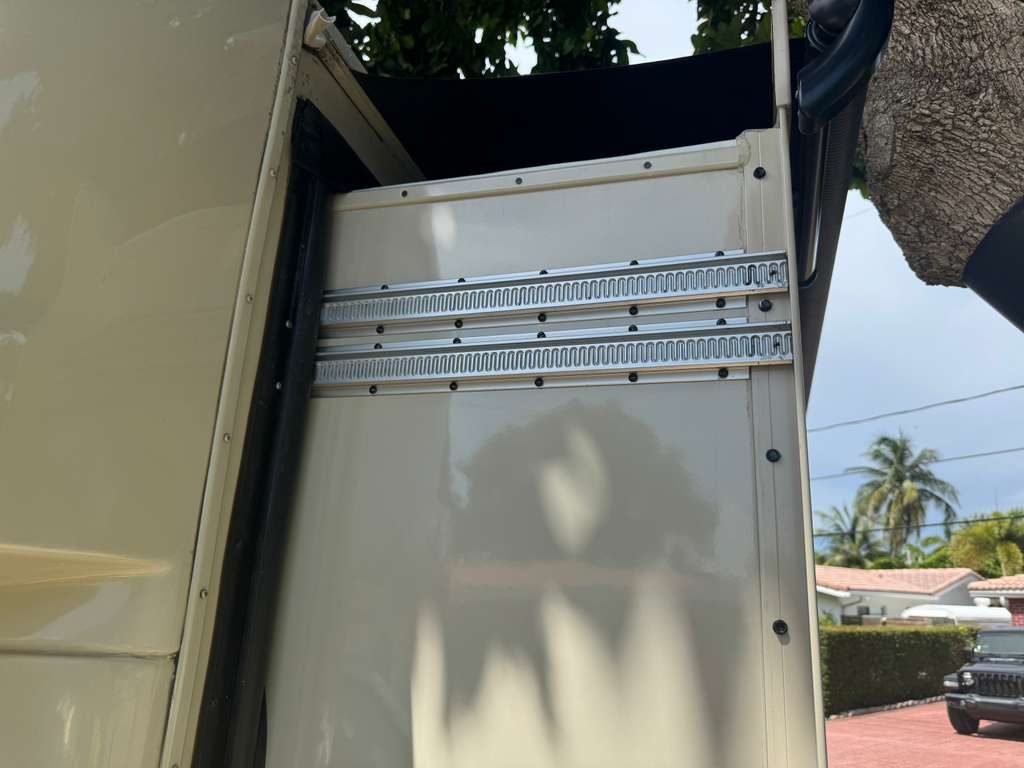
Heat is the dominant enemy of absorption refrigerator performance in Florida summers. The condenser fins on the back of the cooling unit must dissipate heat into the air circulating through the refrigerator compartment behind the back panel. In a rig parked in direct sun at Magnolia Park on a 95-degree July afternoon, the ambient temperature behind the back panel can reach 120 to 130 degrees.
At this ambient temperature, an aging cooling unit with any reduction in ammonia charge will fail to maintain safe food storage temperatures (below 40 degrees Fahrenheit) in the fresh food compartment. The factory-installed baffle system that directs convective airflow through the refrigerator vent is critical in this environment and should be inspected annually - a missing or displaced baffle can increase the back-panel ambient temperature by 15 to 20 degrees, which is the difference between acceptable and unacceptable cooling performance on a hot Florida day.
The Norcold fire recall covers a large number of units built between 2001 and 2011, and we verify recall compliance on every Norcold we service. The recall addresses a failure mode where the boiler heat element can overheat the area adjacent to the refrigerator, igniting combustible materials in the surrounding cabinetry. Given Florida's year-round full-timing RV population - many of whom use their rigs as a primary residence in campgrounds around Winter Garden and Kissimmee - a non-recall-compliant Norcold in a full-time rig is a house fire risk, not an appliance inconvenience.
Compressor refrigerators - Vitrifrigo, Isotherm, and residential units installed in newer Class A motorhomes - perform significantly better in Florida heat than absorption units because their compressors can overcome high ambient temperatures that would stall an absorption cooling cycle. However, the condenser coil in a compressor unit still needs to reject heat, and the oak pollen and road dust that accumulates in the condenser fins reduces efficiency over time.
A residential-style refrigerator in a Class A motorhome that has spent a summer at Disney Fort Wilderness will typically have a measurable reduction in cooling capacity by September from condenser fouling alone. Annual condenser cleaning with a coil brush and low-pressure air restores full capacity and reduces the run-time hours on the compressor.
| Brand / Model | Common Issue in Central Florida |
|---|
| Norcold N1095 / N812 (absorption) | Cooling unit failure from off-level operation and heat soak - the most expensive RV refrigerator repair we see; early warning is slow cooling on hot days before total failure |
| Dometic RM3762 / RM2652 (absorption) | Control board failures from campground voltage spikes - the Dometic circuit board is more sensitive than the Norcold equivalent and benefits from an upstream EMS on shore power |
| Vitrifrigo C90i (12-volt compressor) | Compressor startup failures at low battery voltage - the Vitrifrigo compressor requires a minimum 11.5 volts to start reliably; a battery bank that is drawn down from a night of AC use will cause morning startup failures |
| Norcold 2117 (residential, Class A) | Ice maker module failures from voltage spikes - the ice maker control module is a sensitive electronic component that is not protected by the main EMS on many Class A installations |
| Dometic CFX3 75 (portable 12-volt) | Fan motor bearing failures from Florida dust ingress - the cooling fan bearing in portable units is not sealed for outdoor environments; annual fan bearing inspection prevents the bearing-lock that causes compressor overtemperature |
| Isotherm Cruise 130 (marine/RV) | Thermostat drift in high-ambient environments - the mechanical thermostat in older Isotherm units loses accuracy above 90-degree ambient, causing the unit to run warmer than set point during Florida summers |