RV sewer systems are simple but the failures are unpleasant. The two most common problems are inaccurate tank level sensors (that show full when empty, or vice versa) and failed or leaking dump valves. Both are fixable on-site in most cases.


Sewer odors in the living space are usually caused by a dry P-trap, failed toilet seal, or a cracked sewer vent. We diagnose the source and fix it - you shouldn't have to live with RV sewer smell.
The most common complaint: the black tank sensor always reads full, even right after dumping. The sensors are probes that extend through the tank wall and get coated with waste over time. Commercial enzyme treatments can help, but often the sensors themselves need replacement.
We install aftermarket sensors including SeeLevel II, which uses external capacitive sensors mounted on the tank wall and are immune to the coating problem. A significant upgrade for full-timers and heavy users.
Catching these early saves money and prevents a roadside emergency. Our technicians see these warning signs on service calls across the Winter Garden area every week.
RV sewer and tank service in Central Florida has specific seasonal and environmental factors that make it meaningfully different from tank maintenance in other regions. The warm year-round temperatures that make full-time RV living attractive in this area are also the conditions under which anaerobic bacteria in holding tanks are most active and most odor-productive.
Florida's year-round warmth makes black tank management significantly more challenging than in northern states. At 85 to 95-degree ambient temperatures common in Central Florida from April through October, anaerobic bacteria in the black tank complete their metabolic cycle in hours rather than days, producing hydrogen sulfide and methane at rates that overwhelm the vent system's capacity if the tank is more than 60 to 70 percent full.
We recommend Central Florida RV owners target a maximum 60 percent fill before dumping, and use an enzyme-based treatment - Happy Camper, Unique RV Digest-It, or equivalent - at every fill rather than on the first use after dumping. The enzyme formulations accelerate aerobic digestion of waste, reducing the anaerobic sulfur-producing pathway that creates odor.
Mud dauber wasp nests inside the black and gray tank vent tubes are a Florida-specific problem with significant consequences. Florida's mud dauber wasps build tubular mud nests inside enclosed spaces with small openings - the 1.25 to 1.5-inch diameter tank vent tubes are a preferred nesting location. A blocked vent tube prevents the normal aspiration of tank gases through the roof vent and forces them back into the RV through the toilet valve or the gray tank drain.
We find blocked vent tubes on approximately one in three inspection calls at Central Florida campgrounds. The remedy is a vent tube cleaning with a flexible brush and installation of a fine stainless mesh screen at the vent outlet on the roof - a 30-minute modification that prevents recurrence.
Tank level sensor fouling is nearly universal in Central Florida RVs that use city water with the typical 300 to 500 ppm total dissolved solids. The probe-style sensors used in most RV holding tanks measure electrical conductivity between the probe electrode and the tank wall. As mineral scale from hard water builds up on the probe surfaces, the sensor reads progressively higher than the actual tank level - a full-scale reading on an empty tank is the endpoint of this progressive fouling.
We offer a sensor cleaning service using a tank-safe acid treatment that dissolves the mineral scale from the sensor probes without damaging the tank. This service restores accurate readings in most cases - the exception is sensors where the scale has mechanically trapped the probe in a permanently-shorted position, which requires probe replacement.
The sewer connections at Central Florida campgrounds vary significantly in quality and maintenance. Campgrounds like Disney Fort Wilderness have modern, well-maintained sewer connections, while some of the county parks and private campgrounds in Lake County have older connections with corroded cam-lock fittings that damage RV dump valve outlets.
We recommend using a 4-in-1 adapter kit and inspecting the campground connection before making contact with the RV fitting - a damaged campground fitting can split a plastic dump valve outlet, turning a routine dump into a messy emergency. Carrying a spare 3-inch sewer adapter and a replacement hose end in the RV tool kit is simple insurance.
| Brand / Model | Common Issue in Central Florida |
|---|---|
| Thetford Aqua-Magic Bravura toilet | Ball seal failure causing sewer gas entry into the living space - the Bravura ball seal is a $25 replacement part that should be replaced at the first sign of odor or failure to hold water in the bowl |
| Dometic 320 gravity toilet | Floor flange warp from temperature cycling causing base weeping - a wax-free foam seal replacement addresses base leaks; if the flange is warped, a re-leveling compound restores the sealing surface |
| Valterra T1020 dump valve (standard blade valve) | Blade guide pin failure when forced open with a stuck cable connection - the guide pins are nylon and shear at approximately 40 in-lb of torque; if a valve resists opening, lubricate and gentle rocking before applying force |
| SeeLevel II tank sensor system (aftermarket) | Probe wiring corrosion inside the tank connection port from humidity exposure - the soldered connection inside the sensor well corrodes in Florida's humidity over 5 to 8 years, causing erratic level readings |
| Camco 39623 sewer hose (standard) | Connector end splitting from UV exposure on the bayonet lugs - the plastic bayonet fittings on standard sewer hoses become brittle after 2 to 3 Florida outdoor-storage seasons; replacement hose ends ($8) restore a secure connection |
| Lippert Waste Master sewer hose | Over-extension causing spiral reinforcement to separate from the hose wall - this hose is rated for specific extension lengths; exceeding the rating creates kinks that develop into through-wall cracks |
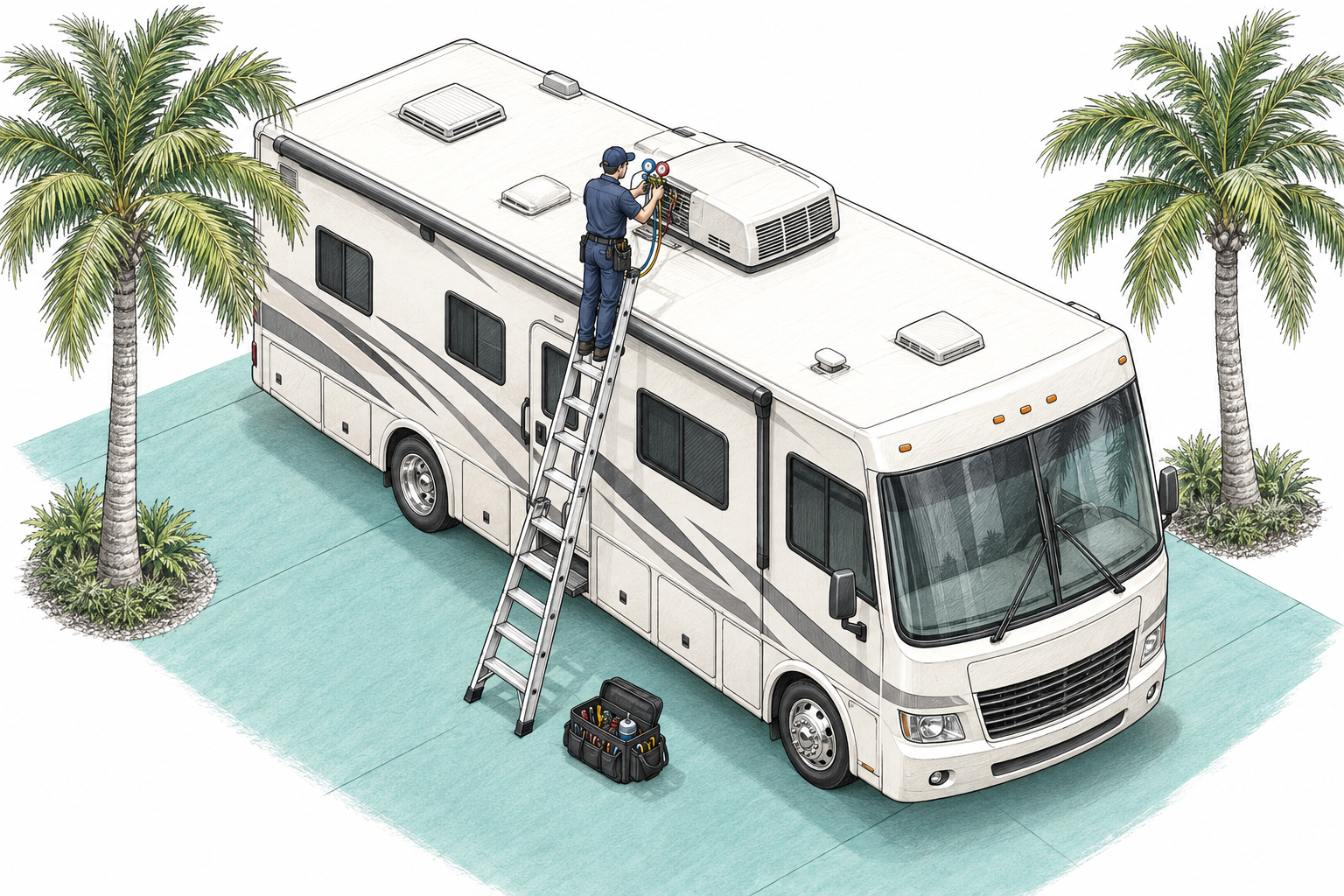
A real call from our service area: A long-term resident at a Kissimmee RV park called us when his 2017 Coachmen Pursuit's black tank dump valve began leaking at the campsite sewer connection during dumping. The original Valterra valve had failed at the gate seal - common after 7 years of use. What made the call more complex: the tank level sensors had been reading full for two years despite regular dumping.
We replaced the dump valve, then installed a SeeLevel II external sensor system on all three tanks (black, gray, and fresh). The owner had been dumping by schedule rather than by level because the probes had failed years ago. Total: $385 for both jobs together.
He now knows exactly how full each tank is for the first time in years.
Probe-style tank level sensors are a universal weakness on all RV brands. The probes extend through the tank wall and become coated with waste over time, causing false full readings. We recommend either a regular enzyme treatment program to maintain probe accuracy, or upgrading to SeeLevel II external capacitive sensors - which are immune to this problem - on any coach where you plan to full-time or use heavily.
Flat-rate quotes given before work begins. Parts and labor included. No surprises.
| Service Type | National Average | Our Flat Rate (Central FL) |
|---|---|---|
| Dump valve replacement (each) | $100 - $250 | $145 - $225 |
| Tank level sensor replacement (probe-style) | $100 - $250 | $145 |
| SeeLevel II external sensor install (3-tank) | $200 - $400 | $245 - $320 |
| Toilet flange seal replacement | $100 - $200 | $125 - $185 |
| Tank flush port installation | $100 - $175 | $125 - $165 |
* Prices shown are estimated ranges based on national and Central Florida market data. Your actual cost is determined on-site by the technician after diagnosis. We quote a guaranteed flat rate before any work begins.
We skip the tow truck and the shop drop-off entirely. Here is exactly what happens when you call RV Repair Winter Garden for rv sewer & tank service:
We provide mobile rv sewer & tank service throughout Clermont, Kissimmee, Apopka, Ocoee, Horizon West, Windermere, Groveland, Minneola, Montverde, Winter Haven, and Orlando, and all of Orange, Lake, and Osceola counties. No travel fee within our core service area.
RV black tank service (flush, clean, enzyme treatment) runs $65 to $125 on a mobile call. Dump valve replacement runs $95 to $195.
Tank sensor repair runs $85 to $165. Odor remediation services run $95 to $225 depending on the severity and cause.
Flush when 2/3 to 3/4 full - never wait until completely full. In Florida's heat, a nearly full or full black tank generates significant odor pressure because waste breaks down faster at high temperatures. Flush every 3 to 5 days for full-time use, or when the tank gauge reads 2/3 full.
We do tank flush services and diagnostic work at your location. For portable pump-out, many campgrounds have on-site dump stations.
In Orange and Lake County, mobile pump-out services are also available from dedicated service providers. We coordinate with pump-out services for our sewer repair calls.
A sewer smell from empty tanks is almost always a failed or dry toilet flap seal, a dry P-trap in the sink or shower (in Florida storage, the trap water evaporates in 2 to 4 weeks, allowing tank gases to rise), or a cracked or poorly routed vent stack. Pour a cup of water down each drain to refill P-traps as the first step.
The black tank collects waste from the toilet only. Gray tanks collect wastewater from sinks and the shower.
Gray tanks are generally less odorous than black tanks but should still be treated with enzyme products in Florida heat. Close both tank valves between dumps; never leave them open, which dries the tank and causes residue buildup.
Tank sensors fail by coating with tissue and solids that cling to the sensor probes, causing false full readings. Using high-quality enzyme treatments that break down solids before they adhere to sensors, and rinsing thoroughly with the built-in tank flush or a tank wand, are the most effective prevention steps. Never use bleach in the black tank - it kills the beneficial bacteria needed for breakdown.
No - Florida law and most campground regulations prohibit dumping any gray or black wastewater except into approved dump stations or sewer connections. Gray water contains food particles, grease, and soaps that are prohibited from direct ground discharge. Always use designated dump stations.
Enzyme-based treatments work best in Florida's high temperatures - they use bacteria that are most active above 75 degrees F. Happy Campers, Unique RV Digest-It, and BioKleen Bac-Out are effective in Florida heat. Avoid formaldehyde-based treatments (Thetford Aqua-Kem original formula) - banned at many Florida campgrounds.
A kinked or cracked sewer hose should be replaced - a leaking sewer connection is a health hazard and most Florida campgrounds will shut you down for a sewer leak. RV sewer hoses cost $15 to $45 and are considered consumable items.
Replace every 2 to 3 years; inspect before each trip. Keep a spare in storage.
Yes - gray tanks develop grease and soap buildup that eventually coats sensors and clogs the tank vent. Flush the gray tank fully after each dump session and treat with an enzyme cleaner. Gray tanks in Florida RVs develop odor from bacterial growth in the biofilm buildup faster than in cooler climates.
Same-day service across Winter Garden and all of Central Florida. Guaranteed flat-rate pricing before we start.