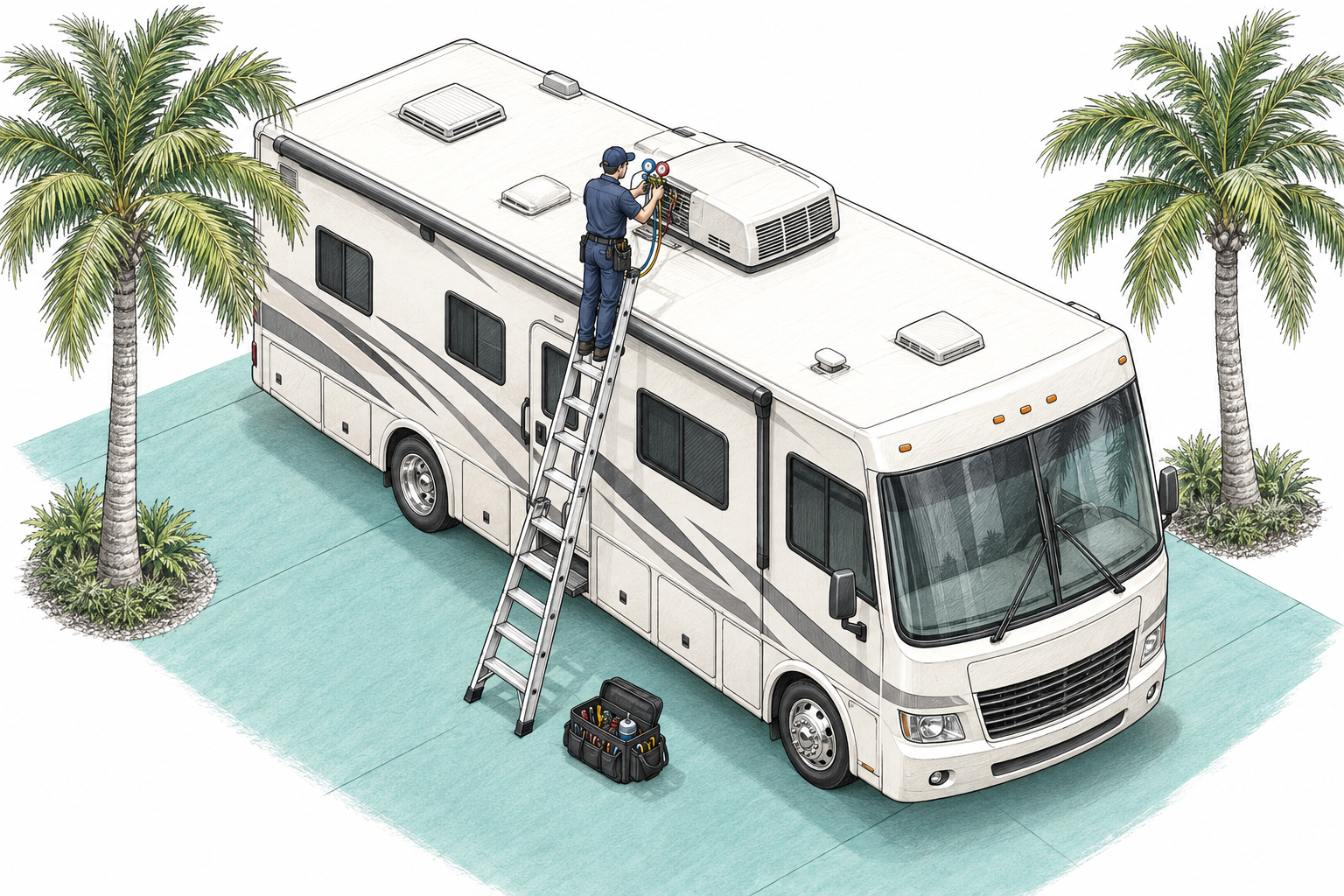
RV Repair Winter Garden provides mobile rv black tank service throughout Orange, Lake, and Osceola counties. Our certified technician comes to your wherever your RV is parked. Flat-rate pricing quoted before we start - no towing required.
Our certified mobile technicians provide rv black tank service throughout Winter Garden and all of Orange, Lake, and Osceola counties. We come to your wherever your RV is parked - no towing, no shop drop-off required.
Feat Slide Out in Winter Garden, FLFeat Ac Repair in Winter Garden, FL
Flat-rate pricing is given before any work begins. You approve the price, we do the work. Available 7 days a week, 7 AM to 8 PM.
A black tank flush and enzyme treatment runs $65 to $95 on a mobile service call. Deep cleaning service for a sensor-coated or odor-persistent tank runs $95 to $145. Sensor replacement as part of a cleaning service adds $65 to $125.
Fill the black tank 1/2 to 2/3 full with water using the built-in flush nozzle or a hand-held tank wand inserted through the toilet. Let it agitate by driving around the block if possible, then dump at a sewer connection.
Repeat the rinse until water runs clear. Close the dump valve and add 2 to 4 gallons of water plus enzyme treatment before the next use.
Toilet paper and solid waste deposits on the sensor probes cause false full readings. The standard fix is a tank cleaning treatment: dump the tank, add 2 gallons of water and a tank cleaning solution (Happy Campers or Geo Method), drive around to agitate, let sit 12 to 24 hours, and dump.
Repeat 2 to 3 times. Probe sensors that are completely coated may need replacement.
The Geo Method: 1 cup of Calgon water softener, 1 cup of Dawn dish soap, and 1 gallon of hot water added to the tank after dumping. Fill the tank halfway with water.
The detergent and water softener break down calcium and solid deposits on the tank walls and sensors. This is a proven low-cost tank sensor remedy that works on most mild-to-moderate coating issues.
Always keep at least 2 to 3 gallons of water in the black tank. Water is essential for the biological breakdown process and for keeping solid waste mobile to the drain when dumping. A dry tank causes solids to pyramid and cake onto the floor, eventually requiring chemical treatment or manual cleaning.
Leaving the black tank valve open is a common mistake - it allows liquid to continuously drain while solids stay behind, eventually building a solid mass that can block the drain entirely. Always keep the dump valve closed and dump when the tank is 2/3 full. The gray tank can be left slightly cracked to prevent overflow if monitoring.
First verify the toilet flap seats completely - a failed flap allows tank gas directly into the RV. Add ice cubes and a black tank enzyme treatment, drive to agitate, and dump. The ice breaks up crusted deposits and the enzyme treatment shifts the tank toward aerobic breakdown, which produces far less odor than anaerobic breakdown.
Never - bleach kills the beneficial bacteria and microorganisms responsible for waste breakdown in the tank. Without bacteria, solids do not break down, sensors coat faster, and odor becomes worse. Enzyme-based treatments depend on live bacteria; bleach is counterproductive in the black tank.
If 3 rounds of Geo Method or enzyme treatment haven't restored accurate sensor readings, if the tank has never been professionally cleaned in 3 or more years, or if there is a persistent odor despite correct treatment, a professional tank cleaning service with a high-pressure tank wand and enzyme soak is the appropriate next step.
Yes significantly - waste breakdown in a Florida black tank on a summer day is far more active than in a northern climate. High temperatures accelerate anaerobic bacterial activity, which produces hydrogen sulfide (rotten egg smell). Keeping the tank from overfilling, maintaining adequate water in the tank, and using high-quality enzyme treatments are more important in Florida than in cooler states.
FAQ
Common Questions
A black tank flush and enzyme treatment runs $65 to $95 on a mobile service call. Deep cleaning service for a sensor-coated or odor-persistent tank runs $95 to $145. Sensor replacement as part of a cleaning service adds $65 to $125.
Fill the black tank 1/2 to 2/3 full with water using the built-in flush nozzle or a hand-held tank wand inserted through the toilet. Let it agitate by driving around the block if possible, then dump at a sewer connection.
Repeat the rinse until water runs clear. Close the dump valve and add 2 to 4 gallons of water plus enzyme treatment before the next use.
Toilet paper and solid waste deposits on the sensor probes cause false full readings. The standard fix is a tank cleaning treatment: dump the tank, add 2 gallons of water and a tank cleaning solution (Happy Campers or Geo Method), drive around to agitate, let sit 12 to 24 hours, and dump.
Repeat 2 to 3 times. Probe sensors that are completely coated may need replacement.
The Geo Method: 1 cup of Calgon water softener, 1 cup of Dawn dish soap, and 1 gallon of hot water added to the tank after dumping. Fill the tank halfway with water.
The detergent and water softener break down calcium and solid deposits on the tank walls and sensors. This is a proven low-cost tank sensor remedy that works on most mild-to-moderate coating issues.
Always keep at least 2 to 3 gallons of water in the black tank. Water is essential for the biological breakdown process and for keeping solid waste mobile to the drain when dumping. A dry tank causes solids to pyramid and cake onto the floor, eventually requiring chemical treatment or manual cleaning.
Leaving the black tank valve open is a common mistake - it allows liquid to continuously drain while solids stay behind, eventually building a solid mass that can block the drain entirely. Always keep the dump valve closed and dump when the tank is 2/3 full. The gray tank can be left slightly cracked to prevent overflow if monitoring.
First verify the toilet flap seats completely - a failed flap allows tank gas directly into the RV. Add ice cubes and a black tank enzyme treatment, drive to agitate, and dump. The ice breaks up crusted deposits and the enzyme treatment shifts the tank toward aerobic breakdown, which produces far less odor than anaerobic breakdown.
Never - bleach kills the beneficial bacteria and microorganisms responsible for waste breakdown in the tank. Without bacteria, solids do not break down, sensors coat faster, and odor becomes worse. Enzyme-based treatments depend on live bacteria; bleach is counterproductive in the black tank.
If 3 rounds of Geo Method or enzyme treatment haven't restored accurate sensor readings, if the tank has never been professionally cleaned in 3 or more years, or if there is a persistent odor despite correct treatment, a professional tank cleaning service with a high-pressure tank wand and enzyme soak is the appropriate next step.
Yes significantly - waste breakdown in a Florida black tank on a summer day is far more active than in a northern climate. High temperatures accelerate anaerobic bacterial activity, which produces hydrogen sulfide (rotten egg smell). Keeping the tank from overfilling, maintaining adequate water in the tank, and using high-quality enzyme treatments are more important in Florida than in cooler states.
RV Problem? We Come to You.
Same-day service across Winter Garden and all of Central Florida. Guaranteed flat-rate pricing before we start.