RV Solar & Battery Service in Winter Garden, FL

RV Repair Winter Garden provides mobile solar panel diagnosis, battery bank upgrades, and charge controller service throughout Orange, Lake, and Osceola counties. Florida's sun is a resource - let us help you use it.

Mobile Service

RV Solar & Battery Service - We Come to Your RV

Solar is the fastest-growing RV upgrade request we receive. A properly sized solar and lithium battery system lets you camp off-grid without running a generator - which means no noise, no fuel cost, and no campground power hookups required. Florida's year-round sun makes the payback period shorter than anywhere in the country.

Feat Ac Repair in Winter Garden FL
Feat Ac Repair in Winter Garden, FL
Feat Slide Out in Winter Garden FL
Feat Slide Out in Winter Garden, FL

We also diagnose and repair existing solar systems - failed charge controllers, degraded panels, undersized wiring, and mismatched components are all common. If your solar system isn't performing as expected, we find out why.

Call (407) 555-0190 Get a Free Quote
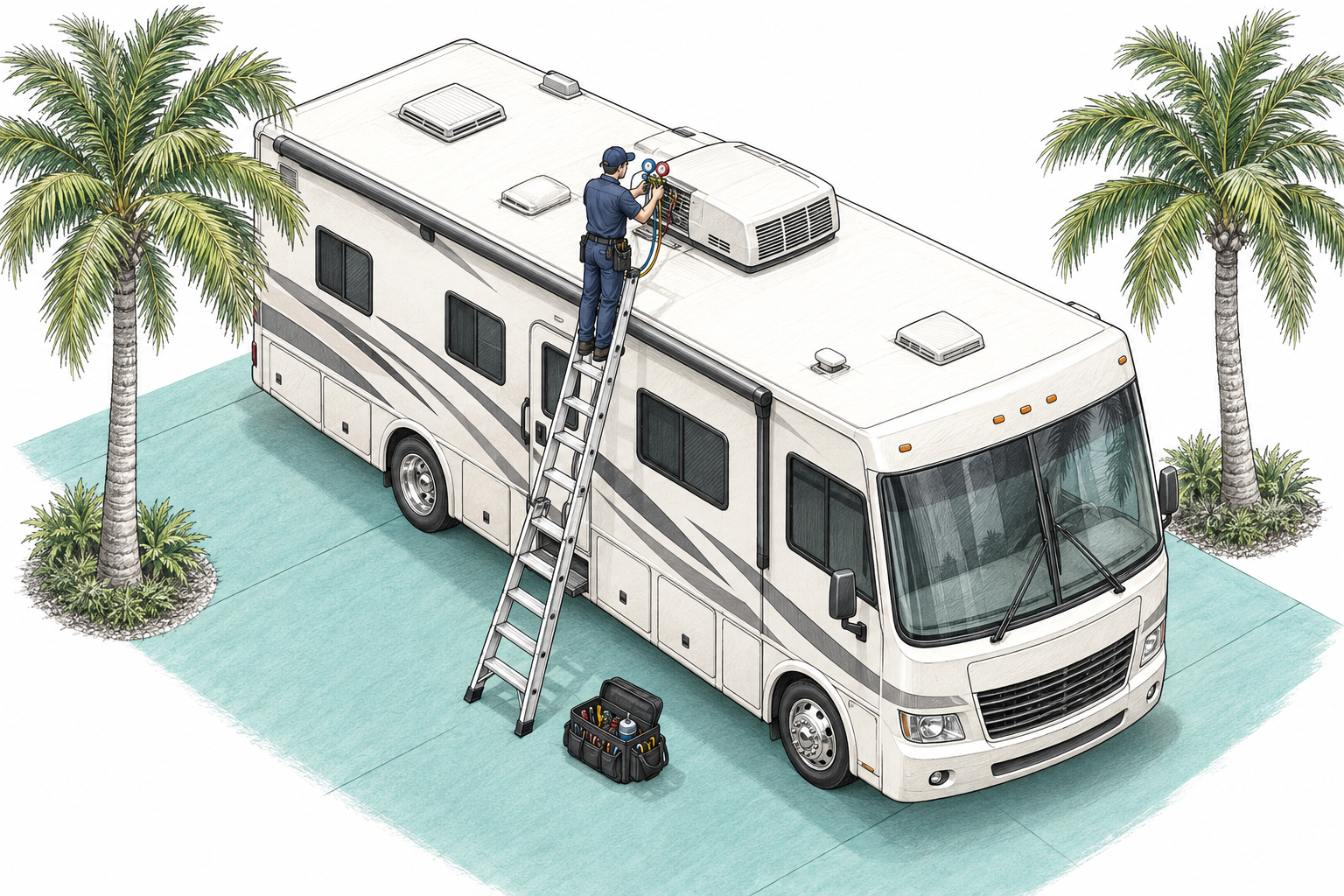
RV Solar & Battery Service in Winter Garden FL by mobile technician
What We Repair

Solar and Battery Services We Provide

  • Solar panel installation (roof-mounted, portable)
  • MPPT and PWM charge controller replacement and configuration
  • Lithium (LiFePO4) battery bank installation - Battle Born, Epoch, Ampere Time
  • AGM battery bank replacement and expansion
  • Battery monitor installation (Victron, Renogy)
  • Shore power and inverter-charger integration (Victron MultiPlus, Xantrex)
  • BMS diagnosis on lithium systems
  • Solar system performance analysis
What You Should Know

How Much Solar Do You Need?

The right size depends on your usage. For casual weekend camping with one rooftop AC unit: 400W solar and 200Ah lithium is a starting point. For full-time living off-grid with two AC units: 1,000W+ solar and 400Ah lithium minimum.

We do a load analysis before recommending system size. An underpowered system is disappointing and wastes money. We size it correctly the first time.

Warning Signs

Signs You Need RV Solar & Battery Service

Catching these early saves money and prevents a roadside emergency. Our technicians see these warning signs on service calls across the Winter Garden area every week.

  • Battery voltage drops below 12.1 volts overnight with no significant loadA fully charged 100Ah lead-acid or AGM battery should hold above 12.6 volts after a night of low draw. A morning reading below 12.1 volts on a bank that was fully charged the prior evening means either a parasitic drain is depleting the battery, one cell has failed, or the bank is significantly undersized for the actual overnight load.
  • Solar panels are receiving full sun but the charge controller shows little or no charging currentLow charging current in full sun means the panels are shaded (even partial shading of one cell in a series string drops the string voltage), the MC4 connectors have high-resistance corrosion, the panel glass is fouled with pollen and dust reducing transmission, or the charge controller itself has a fault.
  • Inverter shuts down under load even with batteries above 50 percent state of chargeAn inverter that shuts down on load with adequate battery voltage is seeing high internal resistance in the battery bank - either the connecting cables have corroded lugs, the battery terminal connections are loose, or the batteries have sulfated and can no longer deliver the peak current the inverter demands.
  • Battery bank voltage reads normal but appliances run poorly or trip GFCIsStable resting voltage with poor load performance points to high-resistance connections between the battery and the load center - corroded lugs, undersized cabling, or a failed fuse holder that is adding resistance to the main positive circuit.
  • Battle Born or other LiFePO4 battery is not accepting charge (BMS locked out)A lithium battery that will not accept charge has triggered its BMS protection circuit - either from an overvoltage event (campground spike), undertemperature (below 32 degrees, which actually does occur on rare Central Florida winter nights), or a cell voltage imbalance that requires a balancing charge.
  • Solar charge controller is not reaching absorption or float stageA MPPT or PWM controller that stays in bulk charge all day and never reaches absorption has either too much load pulling from the battery during the charge cycle, undersized solar array for the battery bank, or a partial shade condition that keeps panel output below what the controller needs to complete the charge algorithm.
  • Swollen, hot, or leaking battery caseA battery with a swollen case or elevated temperature above 110 degrees Fahrenheit is experiencing an internal fault - overcharging, internal short, or thermal runaway in a lithium cell. This is a safety emergency: disconnect the battery and remove it from the RV before further use.
Florida Climate Impact

What Central Florida Does to Your RV's Solar & Battery

Central Florida is one of the best solar production environments in the country - the NREL solar resource data shows the Orlando area receives 5.0 to 5.5 peak sun hours per day annually, and the flat, open terrain of many campgrounds in Lake and Orange counties means panel shading is minimal compared to forested northern campgrounds. Despite this favorable solar environment, we see a significant number of RV solar systems underperforming in Central Florida because of installation quality issues and the specific maintenance challenges Florida's climate imposes.

Panel fouling from oak pollen is the most common and most underappreciated reduction in solar output in Central Florida. The spring pollen season from February through April deposits a dense layer of fine pollen on every horizontal surface, including solar panels. A 1-millimeter pollen layer on a monocrystalline panel can reduce its output by 20 to 30 percent - the pollen partially transmits light but absorbs and scatters the wavelengths that the panel's cells convert most efficiently.

We have measured panel output before and after cleaning at campgrounds like Lake Louisa State Park and found consistent 18 to 22 percent improvements from a simple distilled-water wash. Monthly panel washing is a minimal-effort, significant-reward maintenance step that Florida RV solar owners should build into their routine.

Battle Born LiFePO4 batteries, Epoch, Renogy, and other lithium iron phosphate batteries are increasingly common in Central Florida RVs because full-time and frequent campers at Kelly Park Rock Springs, Magnolia Park, and Wekiwa Springs State Park want multi-day off-grid capability without the weight and maintenance of lead-acid banks. LiFePO4 chemistry is well-suited to Florida's temperature range - these cells perform better in heat than lead-acid and have essentially no risk of thermal runaway under normal operating conditions. The primary challenge we see with lithium systems in this market is BMS lockout from campground power quality issues.

When a campground pedestal experiences a brief voltage spike during an afternoon thunderstorm (a common occurrence throughout Central Florida's convective storm season), the spike can trip the lithium BMS over-voltage circuit. Resetting the BMS requires a specific procedure - disconnecting the battery for 30 seconds and reconnecting - but the real fix is an upstream Progressive Industries or Surge Guard EMS that prevents the spike from reaching the battery bank.

MC4 connector corrosion is a Florida-specific solar maintenance issue. MC4 connectors on rooftop solar panels operate in an environment of high UV exposure, high temperature, and regular wetting from afternoon thunderstorms. The silver-plated contact pins inside MC4 connectors develop a silver oxide tarnish over 3 to 5 years that increases connection resistance measurably.

A pair of MC4 connectors that add 0.1 ohm of resistance to a 20-amp charging circuit dissipate 40 watts as heat - enough to be felt by touch on a hot day and enough to degrade the connector housing over time. Replacing MC4 connectors on any system older than 5 years, and using a solar-panel combiner box rather than long series strings to minimize the number of connectors in series, improves both safety and output.

The combination of high solar production and high cooling loads in Florida creates a system sizing challenge that many first-time solar RV buyers underestimate. An AC unit on a Class B or Class C motorhome draws 12 to 18 amps at 120 volts - equivalent to 1,440 to 2,160 watts.

Running an AC unit on solar and battery requires either a very large array and bank (typically 800W panel plus 200Ah lithium minimum for even intermittent AC use) or an inverter-generator for AC support. We size solar systems realistically for Florida conditions, which means accounting for the AC load rather than assuming the rig will use fans and shade management as is more practical in drier climates.

Brand / ModelCommon Issue in Central Florida
Victron SmartSolar MPPT 100/30Firmware update failures from Bluetooth communication interruptions - always update firmware via a wired USB connection on this unit, not over Bluetooth in a hot environment
Battle Born 100Ah LiFePO4BMS lockout from campground voltage spikes - standard reset procedure restores function; upstream EMS installation prevents recurrence; do not leave on bulk charge indefinitely as some chargers do with lead-acid protocols
Renogy 200W rigid panelJunction box seal failure allowing moisture ingress at the panel back - the silicone seal around the junction box on some production runs has insufficient coverage; re-sealing with self-leveling silicone prevents water entry
Bluetti AC200P solar generatorBattery BMS calibration drift after 200 or more cycles at high ambient temperatures - a full discharge-recharge calibration cycle restores accurate state-of-charge display
Xantrex Freedom XC 2000 inverter-chargerFan bearing noise from dust accumulation in Florida campground environments - the cooling fan bearing should be inspected and re-lubricated annually to prevent the bearing-lock that causes thermal shutdown
Zamp Solar portable panel (100W)MC4 connector failure from being stepped on or driven over during setup - Zamp panels are popular at Central Florida campgrounds but the connector pigtail is vulnerable; field-repairable with replacement MC4 connectors and a crimping tool
Real Scenario

A Recent RV Solar & Battery Service Call in Our Service Area

A real call from our service area: A Horizon West family wanted to spend a month boondocking in the Ocala National Forest after being dependent on campground hookups their entire RV life. They had a 2020 Keystone Montana with no solar. We designed and installed a 600W rooftop solar system with a Renogy 40A MPPT controller and 200Ah Battle Born LiFePO4 battery bank, plus a 2,000W Renogy inverter.

Total installed cost: $3,400. On their first Ocala trip, they ran the microwave, charged devices, watched TV, and kept the AC running on mild evenings - for 28 days without plugging in once. They estimate they've saved approximately $1,800 in campsite hookup fees in the first year alone.

Florida's year-round sun makes the math on solar unusually favorable. With 5+ peak sun hours per day year-round in Central Florida compared to 3-4 in most of the northern US, the same solar array produces significantly more energy here than anywhere else the coach might travel. Our standard sizing recommendation for Central Florida boondocking with occasional AC use: 400W minimum, 800W for comfort.

Flat-Rate Pricing

Pricing for RV Solar & Battery Service

Flat-rate quotes given before work begins. Parts and labor included. No surprises.

Service TypeNational AverageOur Flat Rate (Central FL)
Solar system diagnosis and performance test$100 - $250$195
Single 200W panel installation (labor)$100 - $250$145 - $225
MPPT charge controller replacement (labor)$100 - $200$165 - $280
100Ah LiFePO4 battery installation (labor)$150 - $300$195 - $285
Full solar + battery system (call for quote)$2,000 - $8,000Call for quote

* Prices shown are estimated ranges based on national and Central Florida market data. Your actual cost is determined on-site by the technician after diagnosis. We quote a guaranteed flat rate before any work begins.

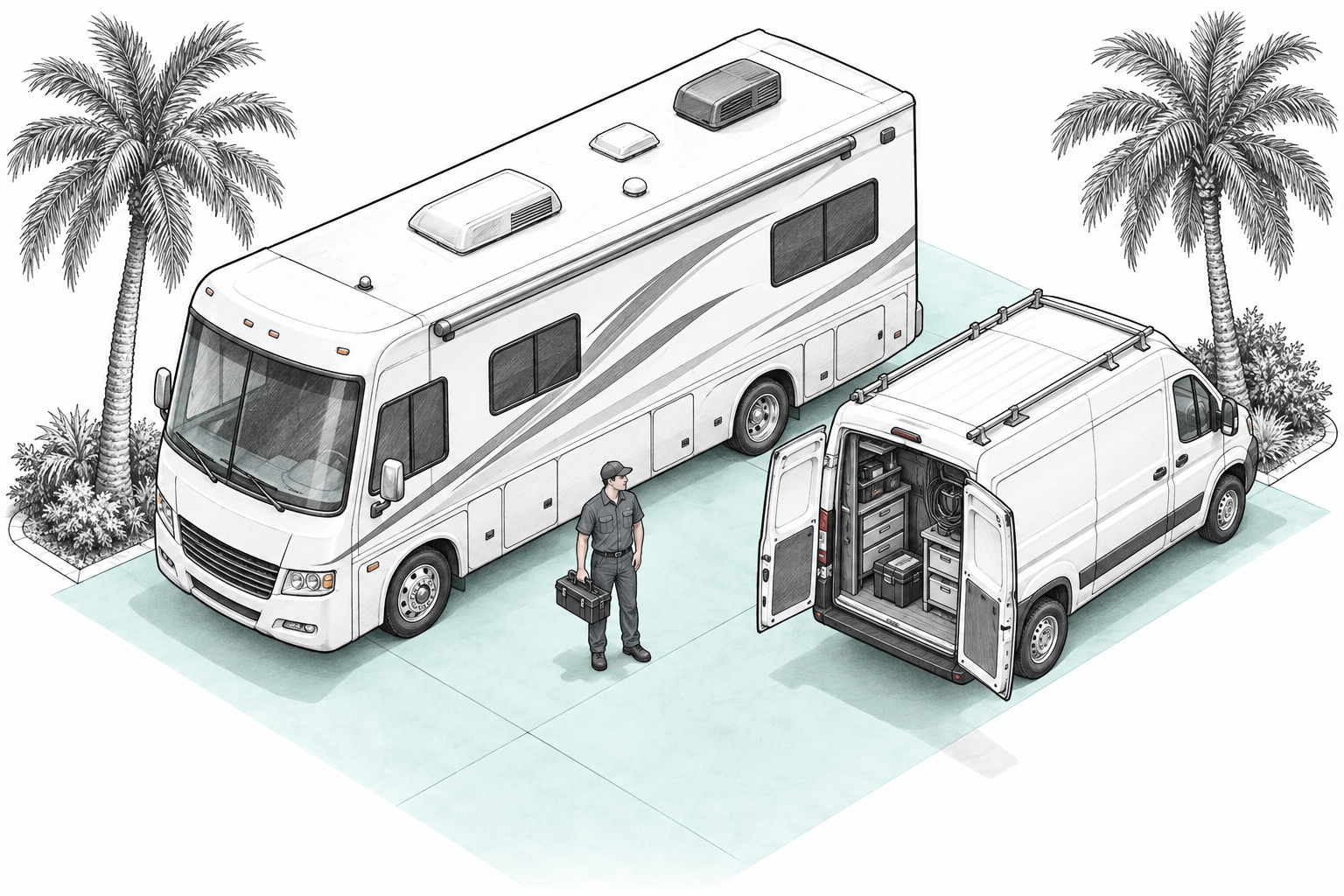
Mobile RV technician performing rv solar & battery service in Winter Garden FL
Our Process

How Our Mobile Solar & Battery Works

We skip the tow truck and the shop drop-off entirely. Here is exactly what happens when you call RV Repair Winter Garden for rv solar & battery service:

  1. 1Call or text us. Describe the problem and your RV location. We quote you a guaranteed flat rate before anyone drives out - no on-site diagnosis fee.
  2. 2Tech arrives at your location. Our certified technician drives directly to your wherever your RV is parked with the parts and tools for your repair.
  3. 3Repair completed on-site. We fix your RV right where it sits. Most rv solar & battery service jobs are done in a single visit. No towing, no shop, no waiting days for an appointment.
  4. 4Pay the flat rate you were quoted. The price we quoted is the price you pay. If we find something extra, we quote it separately before touching it.
Get a Free Quote - (407) 555-0190
Specific Services

All RV Solar & Battery Service Services

Coverage

Service Areas

We provide mobile rv solar & battery service throughout Clermont, Kissimmee, Apopka, Ocoee, Horizon West, Windermere, Groveland, Minneola, Montverde, Winter Haven, and Orlando, and all of Orange, Lake, and Osceola counties. No travel fee within our core service area.

Related Services

You May Also Need

FAQ

Common Questions

A basic 200-watt starter solar kit (two 100W panels, charge controller, and wiring) installed runs $550 to $950. A full off-grid system with 400 to 600 watts of solar, a 200Ah lithium bank, and an MPPT charge controller runs $2,200 to $4,800 depending on battery chemistry and inverter size.

Running a 13,500 BTU AC unit from solar alone is not practical with current technology for most RVers - the AC draws 1,200 to 1,500 watts continuously, requiring 6,000+ watts of panels to sustain operation in full Florida sun. Solar supplements AC use by charging batteries between uses or running the AC for 1 to 2 hours when combined with a 3,000-watt inverter and a large lithium bank.

Lithium iron phosphate (LiFePO4) is the clear best choice for Florida solar systems - it tolerates Florida's high ambient temperatures far better than lead-acid chemistries, provides usable capacity down to 100% discharge (vs. 50% for lead-acid), charges faster from solar, and lasts 8 to 15 years. The higher upfront cost is offset by longevity and performance.

Lithium batteries in a Florida RV solar system last 8 to 15 years. AGM batteries last 4 to 6 years under solar cycling.

Flooded lead-acid last 2 to 4 years under daily cycling. Heat is the primary life-shortener for lead-acid chemistry; lithium tolerates Florida temperatures far better.

Yes - if the roof penetration is routed through an existing cable entry or gland, and the charge controller is mounted near the battery compartment, most installations avoid ceiling wire runs. We assess the most practical route for each RV and discuss options before drilling any holes.

A 100-watt panel in Florida produces 60 to 80% of rated output on average over a day (accounting for sun angle and clouds), meaning roughly 500 to 600 watt-hours per day per panel. This is higher than most U.S. states due to Florida's sun hours averaging 5.5 to 6.5 hours of peak production daily in Central Florida.

Yes - we check panel open-circuit voltage and short-circuit current, charge controller input and output readings, battery connection voltage, and wiring continuity. Most solar system failures are a faulty charge controller, corroded roof wiring connections (Florida humidity accelerates corrosion at roof penetrations), or shaded/dirty panels.

For full-time shore power users, solar ROI is limited but still useful for: powering systems during unhooking/moving, providing backup during power outages, and eliminating generator use for occasional boondocking. For even moderate off-grid use, solar pays back in eliminated generator fuel costs within 2 to 4 years.

MPPT (Maximum Power Point Tracking) controllers extract 15 to 30% more energy from panels than PWM controllers, especially in partially cloudy Florida conditions. MPPT is worth the extra cost ($30 to $80 more) for any system with more than 200 watts of panels or with 24V panels charging a 12V battery bank.

Yes - a single 100-watt panel with a good MPPT controller will maintain a 100Ah battery bank and compensate for self-discharge during storage. This is one of the most cost-effective solar applications - it eliminates the need to connect a shore power charger and prevents sulfation damage in stored lead-acid batteries. We install storage-maintainer solar setups in 2 to 3 hours.

RV Problem? We Come to You.

Same-day service across Winter Garden and all of Central Florida. Guaranteed flat-rate pricing before we start.